Balancing Act: The Art of Inverted Pendulums
JUMTC
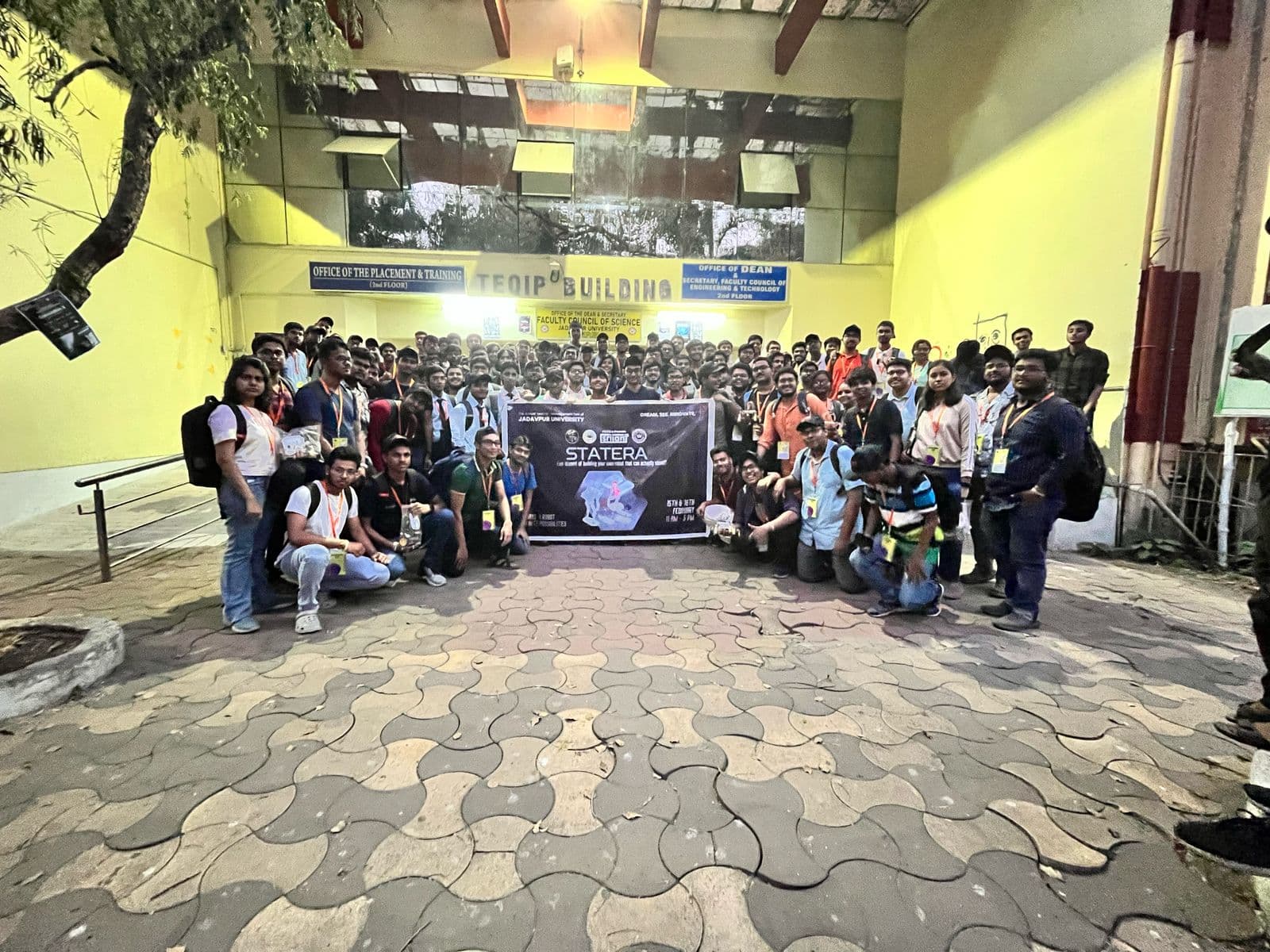
There's something magical about watching a two-wheeled robot stand upright, fighting gravity with nothing but code and physics. That magic was the theme of Statera, our exclusive workshop on self-balancing robots. It was an intense crash course in control theory, embedded systems, and mechanical design.
The Concept
A self-balancing robot is essentially an inverted pendulum—a classic control theory problem. The center of mass is above the pivot point, making it inherently unstable. To keep it upright, the wheels must constantly move in the direction of the fall.
It requires a fast control loop, precise sensor data, and a well-tuned PID (Proportional-Integral-Derivative) controller. If the robot leans forward, the wheels speed up forward. If it leans back, they reverse. The trick is doing this hundreds of times per second.
Hands-On Learning
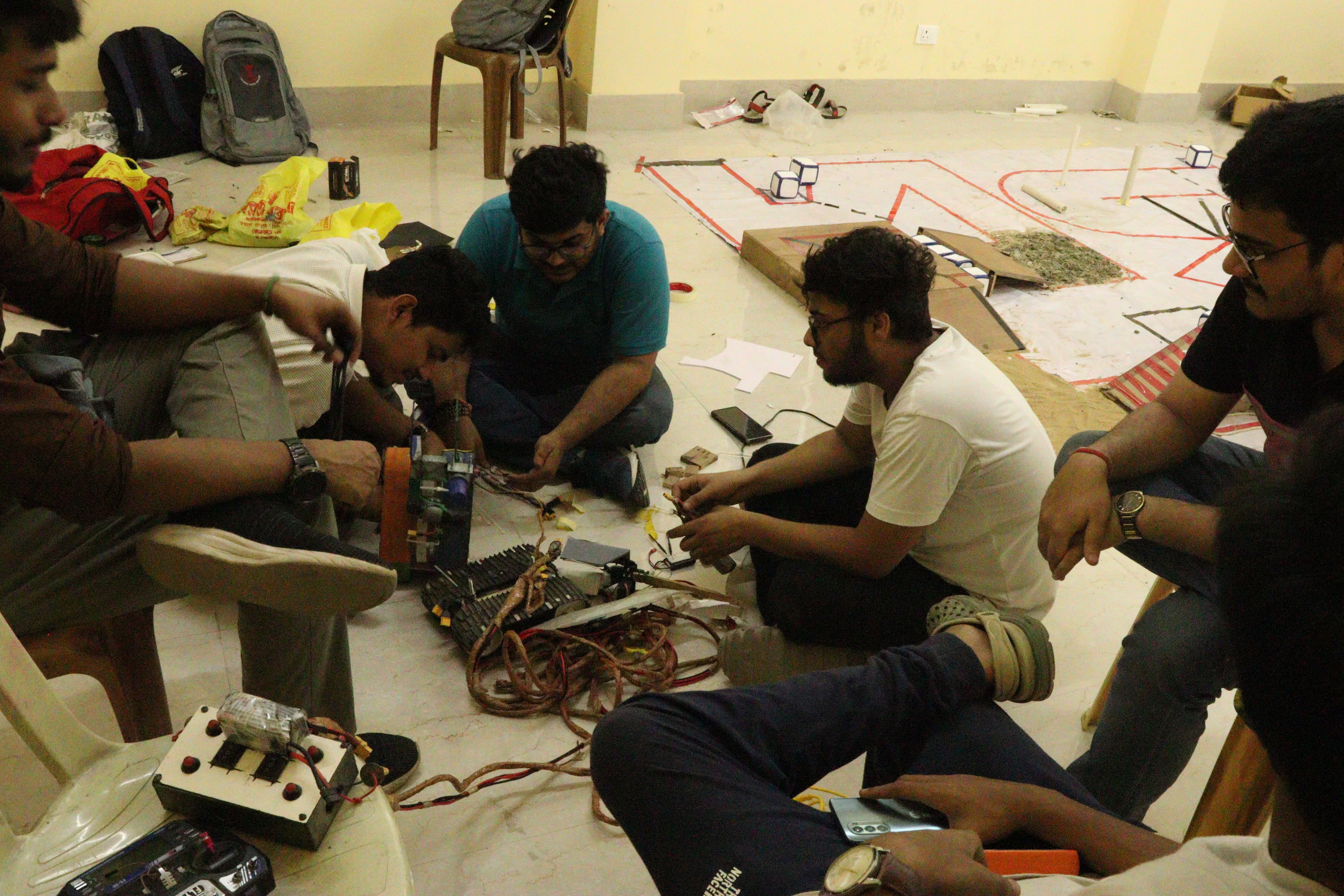
We didn't just want to lecture; we wanted to build. Over two days, 150 participants were divided into teams and given a kit containing:
- Arduino Uno: The brain of the operation.
- MPU6050: A 6-axis IMU (Accelerometer + Gyroscope) to measure the tilt angle.
- L298N Motor Driver: To control the high-power DC motors.
- Custom Chassis: 3D-printed parts designed by our mechanical team.
The Process
Day 1 focused on assembly and sensor interfacing. Students learned how to solder, how to read raw data from the IMU, and how to use a Complementary Filter to fuse noisy accelerometer data with drifting gyroscope data for a stable angle estimate.
Day 2 was all about the PID algorithm. We explained the math without getting bogged down in equations, focusing on intuition:
- P (Proportional): Reacts to the current error (tilt).
- I (Integral): Corrects accumulated error (drift).
- D (Derivative): Predicts future error (dampens the oscillation).
Teams spent hours tuning their Kp, Ki, and Kd values. There were crashes, runaway robots, and frustration—followed by the pure joy of seeing their creation finally stand still.
Outcome
By the end of the workshop, over 90% of the teams had a working balance bot. We concluded with a "push test" competition, seeing whose robot could withstand the strongest shove without falling.
Statera wasn't just about robots; it was about demystifying control theory and showing that complex engineering concepts can be mastered with a bit of patience and a lot of enthusiasm. We are already planning Statera 2.0 with even more advanced challenges.