FALCON: A Bio-Inspired Ornithopter Redefining Autonomous Aerial Robotics
Robofest 5.0
From Jadavpur University, Team FALCON presents a lightweight, stealth-capable ornithopter that merges bio-inspired flight with advanced autonomy. Featuring dual-processing control, sensor fusion, and SLAM-based navigation, the system delivers efficient, low-noise aerial operation for applications ranging from wildlife monitoring to disaster response.
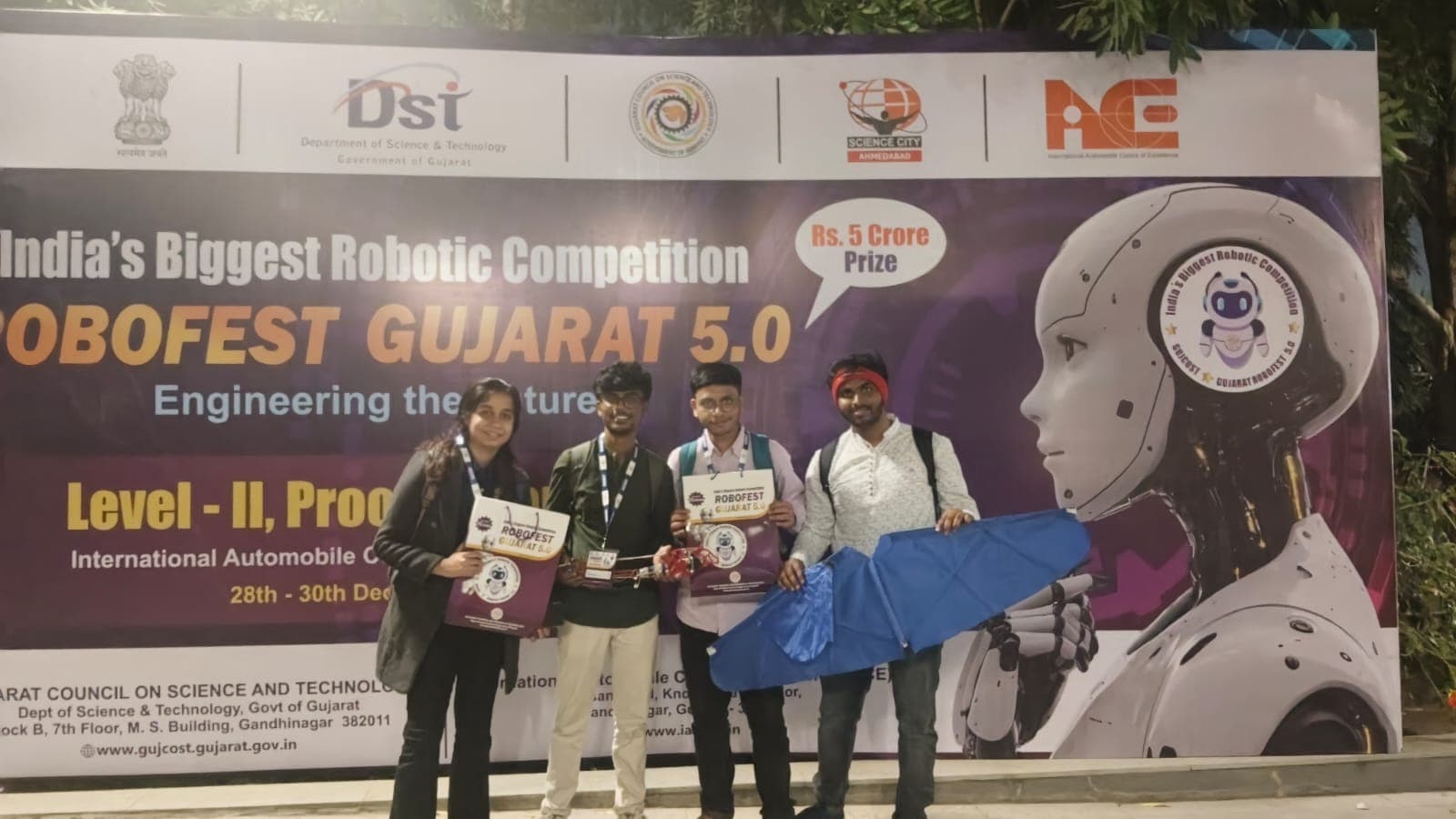
We are proud to introduce Team FALCON from Jadavpur University. Under the mentorship of Prof. Rana Saha, our team—Sibshankar Mondal (Lead), Mainak Dawn, Ushni Datta, and Nirupam Das—has developed a Bio-Inspired Ornithopter
The Engineering of Flight: Lightweight & Rugged
To achieve lift through flapping, weight is our greatest enemy. Our design utilizes a sophisticated blend of materials to maintain a 600 mm wingspan while keeping the total weight of the electronics and power system under 200g.
-
The Skeleton: We used Laser-cut Carbon Fiber sheets (1.5-2 mm) for the main frame because of their extreme stiffness-to-weight ratio.
-
The Wings: The wing membranes are crafted from 20D Ripstop Nylon (parachute grade), providing the durability to withstand repeated flexing and minor impacts that would shatter fragile Mylar.
-
The Mechanism: A DC/BLDC motor drives a custom gear reduction system (approx. 10:1 ratio) to achieve a flap frequency of 4-6 Hz.
The Brain: Dual-Processing Intelligence
Our ornithopter doesn't just flap; it perceives. We implemented a dual-controller architecture to handle both flight stability and high-level autonomy:
-
Flight Control (Inner Loop): An STM32H743 microcontroller handles PID and Model Reference Adaptive Control (MRAC) to stabilize the bot at frequencies up to 400Hz.
-
Companion Computing (Outer Loop): A Raspberry Pi Zero 2 W manages the "heavy lifting," including video streaming and AI-based sensing.
Advanced Perception & SLAM
By integrating a suite of sensors—including ToF LiDAR (TFmini-S), a Bosch BMI088 IMU, and a Pi Camera v2—the Falcon is capable of sophisticated environmental mapping.
-
Sensor Fusion: We use an Extended Kalman Filter (EKF) to fuse GPS, IMU, and LiDAR data for real-time state estimation.
-
Autonomous Navigation: The system is designed for SLAM (Simultaneous Localization and Mapping) using ORB-SLAM2 for vision and Google Cartographer for LiDAR, allowing the "bird" to navigate even in GPS-denied environments.
Why an Ornithopter?
Beyond the technical challenge, the Falcon offers a novelty that traditional quadcopters cannot match: stealth. Its nature-inspired design allows it to blend into the environment, making it ideal for:
-
Wildlife Monitoring: Observing animals without the disruptive buzz of rotors.
-
Covert Surveillance: A bird-like profile for discreet urban or security monitoring.
-
Disaster Response: Navigating confined, hard-to-reach spaces for search and rescue.