Team Matrix
Robofest 5.0
At Robofest Gujarat 5.0, our project started as a simple idea—creating a robot that doesn’t struggle when the terrain changes. Through countless discussions, iterations, and hands-on building, it evolved into a system that can switch between speed and stability depending on the situation. After securing 1st place in the ideation round and successfully clearing the proof-of-concept stage, we are now heading into the finals, continuing to refine and push the project further.
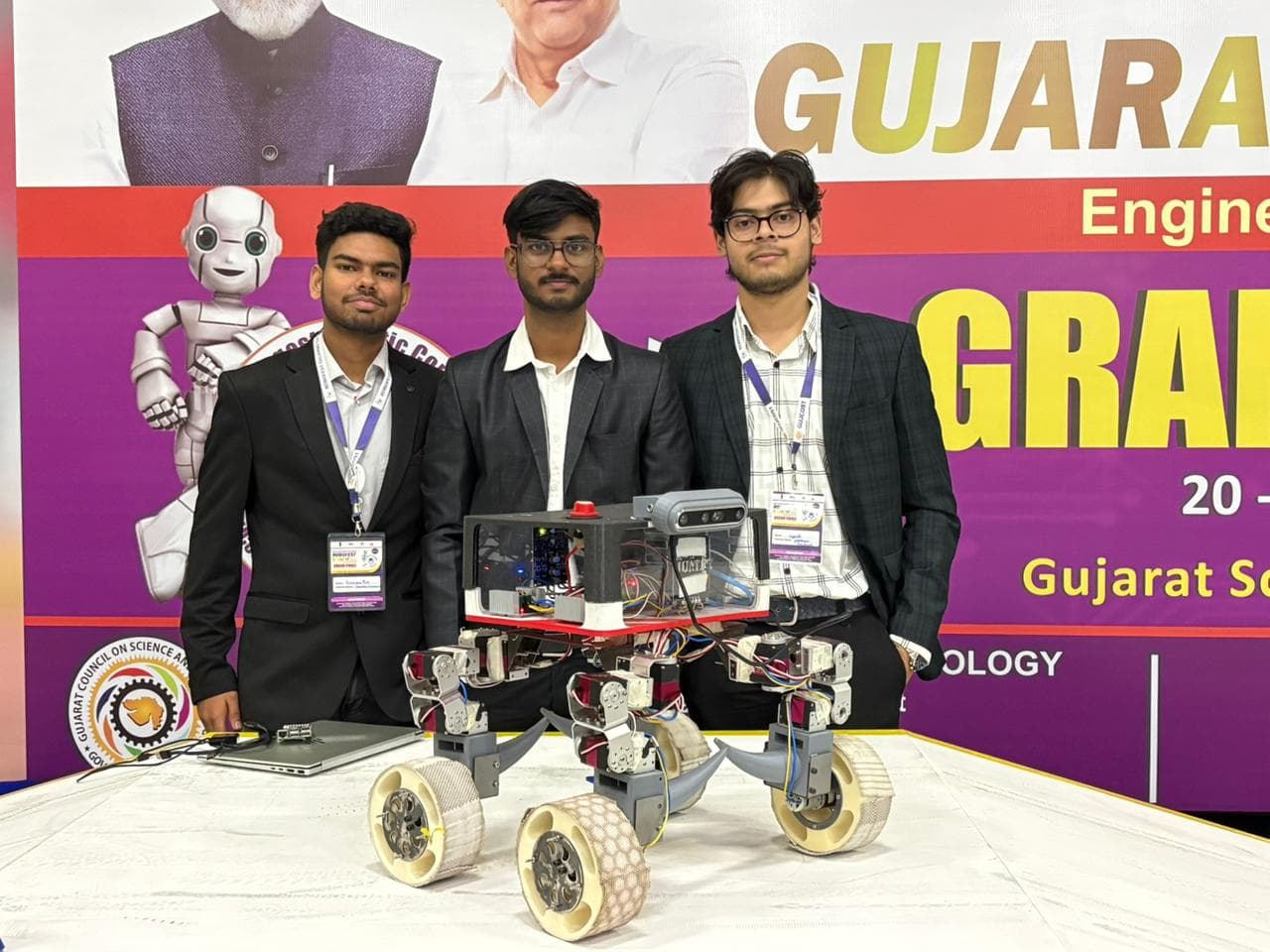
Built to Adapt: Our Robot’s Journey
How It Started
It began as a casual discussion in the club room: why do most robots struggle the moment the terrain changes? Wheels are fast, but limited. Legged systems are flexible, but slow and complex. We wondered if we could build something that didn’t have to compromise. That turned into late evenings in the club room, whiteboard sketches that made sense only at 2 AM, and a lot of debates, most of which felt like unofficial weekly spats. Somewhere between arguing over designs and actually building them, the idea took shape.
What Makes It Different
Most robots pick a side: speed or adaptability. We didn’t want to.
Our robot is built around a morphing concept. It can switch between a wheel-driven mode for speed and a crawl-like configuration for rough terrain. Instead of being locked into one form, it adapts depending on what’s in front of it.
The Morphing Mechanism
The mechanism lets the robot physically reconfigure itself. On flat ground, it behaves like a fast rover. The moment things get messy—obstacles, uneven terrain—it shifts into a crawl mode with better grip and stability.
The goal wasn’t to make something flashy. It was to make something that actually works when conditions aren’t ideal.
Degrees of Freedom
The robot has 16 actuation degrees of freedom, powered by 12 servo motors. Each joint is placed with intent, helping the robot change its shape, maintain balance, and move in a controlled way.
All of this runs autonomously, with the system coordinating each actuator in real time. So instead of individual movements, you get smooth, purposeful motion.
System Architecture
At a high level, the system is split between a Raspberry Pi 5 for high-level processing and an ESP32 for low-level control.
The Raspberry Pi handles perception and decision-making, processing sensor data and planning actions. The ESP32 takes care of precise motor control, ensuring real-time responsiveness.
Together, they form a tight feedback loop of sensing, deciding, and acting—allowing the robot to adapt continuously to its environment.
Hardware Highlights
The build is a mix of practicality and iteration (and a fair bit of trial and error):
- 3D printed claws for better grip on uneven surfaces
- A compact electronics enclosure to keep things safe (and less messy)
- A rigid aluminium base plate forming the structural backbone
- The Intel RealSense D455 depth camera for perception and environment mapping
Milestones
We secured 1st place in the ideation round, which honestly felt like, “okay, maybe this idea isn’t crazy.”
Then came the Proof of Concept round, where we had to prove it actually works: and we made it through.
Now, we’re headed to the finals.
- Anik Das
- Sagnik Sen
- Shreyash Ray
- Srish Dutta