7 Days, 4 Friends, and a Micromouse: Our Journey to NSSC 2023 Glory
National Students Space Challenge IIT KGP
In November 2023, members of the newly formed Jadavpur University Mechatronics Club achieved a significant milestone by securing the first prize in the Micromouse competition at the National Students' Space Challenge (NSSC) held at IIT Kharagpur.
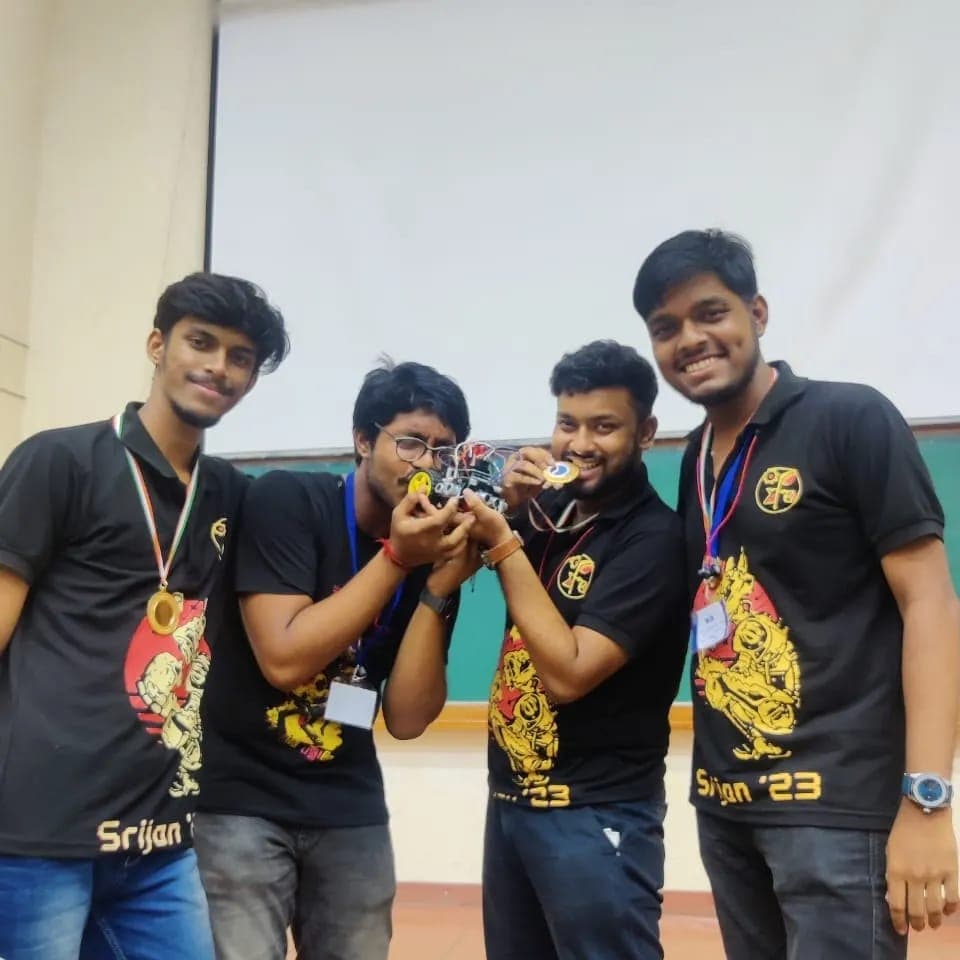
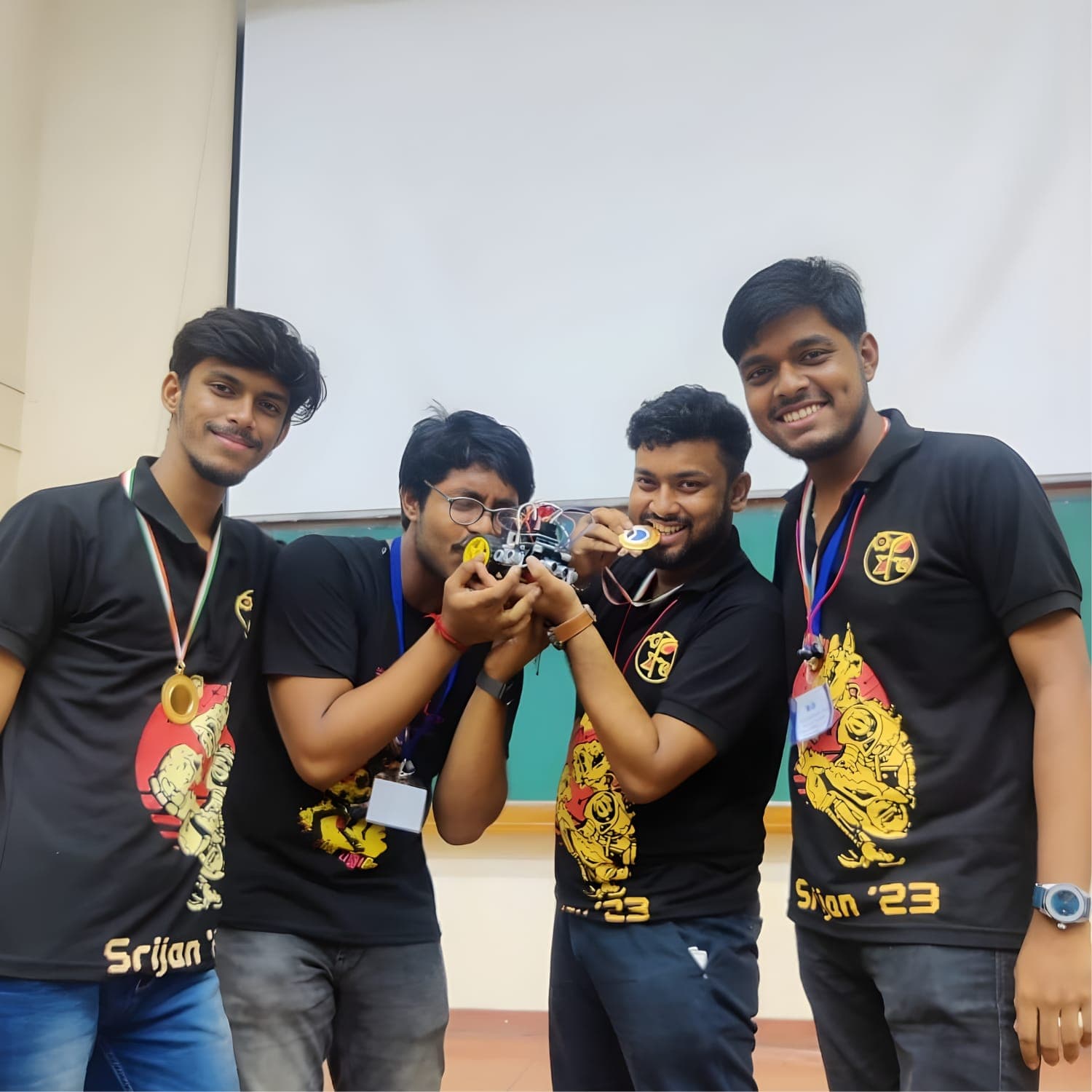
Winning 1st Place at the National Students’ Space Challenge (NSSC), IIT Kharagpur, wasn’t a result of months of clinical planning. It was the result of seven days of sleepless nights, cardboard mazes, and a "barely working" robot that refused to quit.
This is the story of how the Mechatronics Club of Jadavpur University hit its first major milestone.
The "7-Day" Countdown
Most teams spend months on a Micromouse. We had one week. Our team—Sayan (Team Lead), Saptarshi, Diptanshu, and Animesh—practically moved in. For seven days straight, the floor was covered in solder, wire strippers, and empty coffee mugs.
The Chassis Crisis
Our biggest enemy wasn't the code; it was physics. We failed at aligning the tires multiple times. A Micromouse needs to move in a perfectly straight line, but our motors kept veering. We had to rebuild the chassis from scratch repeatedly, fighting against mechanical misalignment that threatened to derail the project before it even reached the train station.
Technical Deep Dive: Making the Mouse "Think"
While the hardware was held together by hope and precision, the software had to be rock solid.
1. The Algorithm: Left Hand on Wall
Due to the tight timeline, we opted for the Left-Hand-on-Wall algorithm. While simpler than a full Flood-Fill, it is highly effective for "simply connected" mazes.
- Logic: The robot maintains a constant "touch" on the left wall. By following this continuous boundary, the mouse is guaranteed to find the exit of any maze where the walls are connected to the outer boundary.
2. The Sensors: Ultrasonic Precision
We utilized Ultrasonic Sensors to calculate the distance from the walls. To ensure the bot didn't bounce between walls like a pinball, we implemented a PID (Proportional-Integral-Derivative) Controller.
$$u(t) = K_p e(t) + K_i \int e(t) dt + K_d \frac{de(t)}{dt}$$
-
P (Proportional): Corrected the steering based on the current distance error.
-
I (Integral): Eliminated the steady-state error (constant drifting).
-
D (Derivative): Predicted future errors to dampen the steering and prevent over-correction.
The IIT Kharagpur Showdown
We arrived at IIT KGP with a "barely working" model. We were exhausted, and compared to the polished bots from other IITs and NITs, our mouse looked like an underdog.
We had two runs. Against all odds, the PID held. The sensors tracked. The mouse traced the maze successfully twice, navigating the turns with surprising grace.
However, looking at the competition, we felt our performance wasn't "gold medal" material. Dejected and convinced we had lost, we packed our bags and headed straight to the Kharagpur Railway Station, skipping the valedictory session entirely.
As we sat on the platform waiting for the train back to Kolkata, a notification popped up. An email from the NSSC organizers.
"Congratulations! Team Vroom Vroom has secured 1st Place in the Micromouse event."
The mood shifted from gloom to pure adrenaline in seconds. We weren't just on the board; we had won it all. We rushed back from the station to the IIT KGP campus, breathless, just in time to attend the session and lift the trophy for Jadavpur University.
The Milestone
This wasn't just a win for us; it was the first major milestone for the Mechatronics Club, JU. It proved that even with 7 days and a cardboard maze, solid engineering and a bit of "Jugaad" can beat the best in the country.