Swarm Intelligence for Minefield Rescue: Team Drone Minds
Robofest 5.0
A team from Jadavpur University engineered a four-drone collaborative swarm to autonomously detect mines and guide a person to safety within minutes. Combining dual-processor architecture, thermal and optical sensing, and intelligent algorithms like Boid’s and A*, the system delivers real-time, safe-path navigation through hazardous terrain.
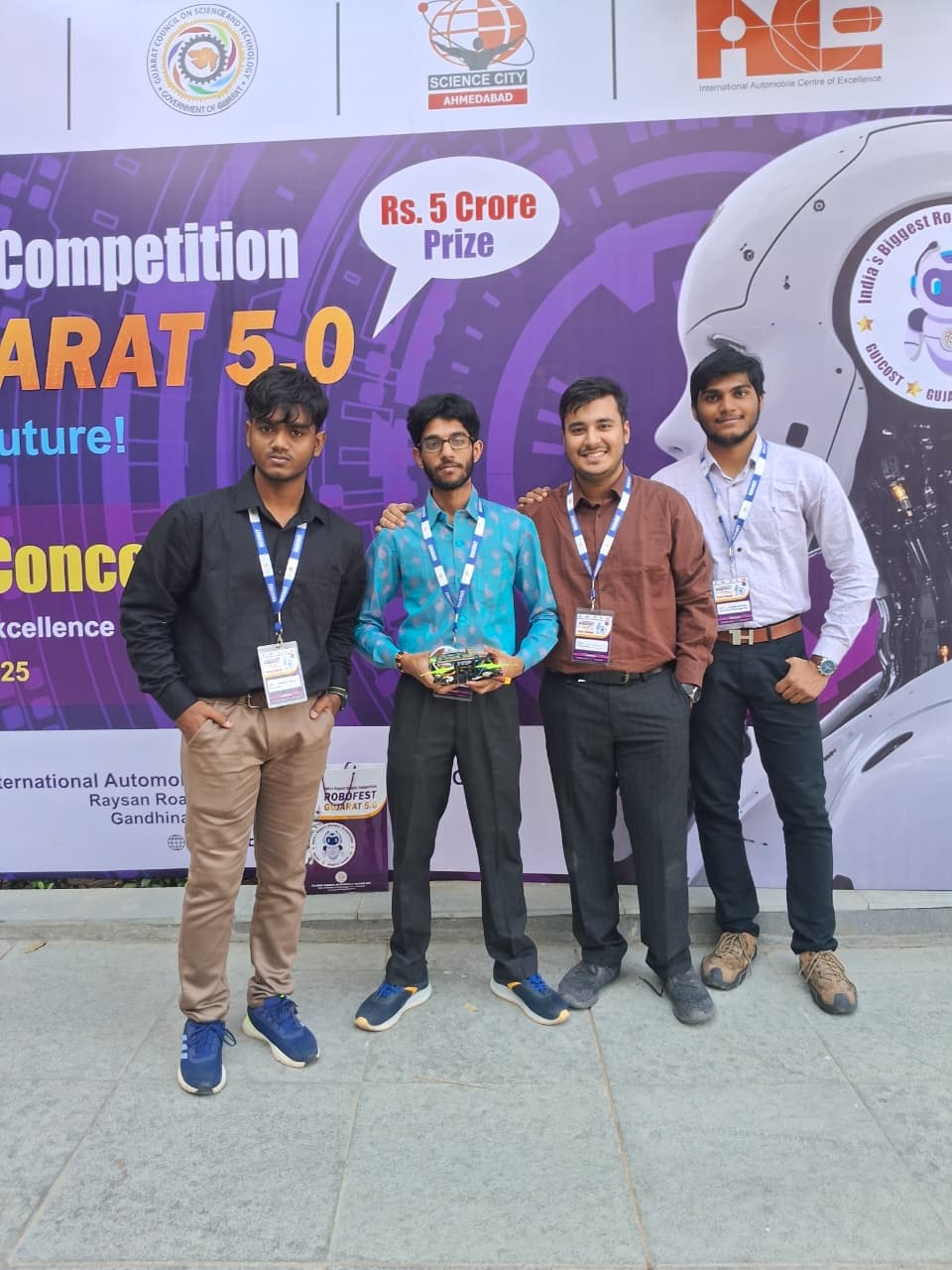
In the Robofest Gujarat 5.0 Aerial Robotics Challenge, the mission of Team Drone Minds from Jadavpur University was to navigate a 100-meter minefield and guide a person-at-risk to safety—all in under 10 minutes. Our approach wasn't just about one drone; it was about a collaborative swarm of four micro-aerial vehicles. Inspired by the natural movements of birds, we implemented Boid’s Algorithm to ensure our drones stayed coordinated, avoided collisions, and worked together as a single unit.
The "Dual-Brain" Architecture
Each drone in our swarm is equipped with two "brains" to handle the intense computational load required for autonomous rescue:
-
The High-Level Brain (Raspberry Pi 4): Handles the "heavy lifting"—vision processing, thermal mapping, and path planning.
-
The Real-Time Brain (ESP32-S3): Manages flight stabilization and motor control with ultra-low latency.
Seeking the Invisible: Mine Detection
To find hidden threats, we combined two distinct types of "vision":
-
Optical Vision: An ArduCAM B0466R (12.3 MP) provides a high-resolution wide-angle view to spot surface obstacles.
-
Thermal Vision: A Melexis MLX90640 thermal sensor detects the unique heat signatures of buried mines.
Designing for Survival
Weight and durability are critical when flying over a minefield.
-
The Frame: We used PETG for the chassis because it’s tough enough to absorb impacts but light enough to keep the drone under 500g.
-
Topology Optimization: We didn't just build a frame; we used math to remove material from low-stress areas, creating a "honeycomb" style structure that is both strong and incredibly lightweight.
Human in the Loop: Gesture Control & Guidance
What makes our system truly unique is how it interacts with the person it's trying to save.
-
Gesture Commands: The human operator can direct the swarm using simple hand gestures. The leader drone’s camera interprets these signals and relays them instantly to the rest of the swarm.
-
The Shortest Safe Path: Using a modified A Algorithm*, the leader drone calculates a "safe corridor" that maintains at least a 1-meter clearance from all detected mines.
-
Real-Time Guidance: This safe path is then displayed on the user's mobile app, giving them a clear, digital roadmap to safety.