Voyager Nexus: Redefining Autonomous Roving at Robofest 5.0
Robofest 5.0
With our latest project for Gujarat Robofest 5.0, Team Voyager Nexus Representing Jadavpur University, this Intelligent Ground Vehicle (IGV) is our answer to the challenge of navigating complex, unstructured terrains.
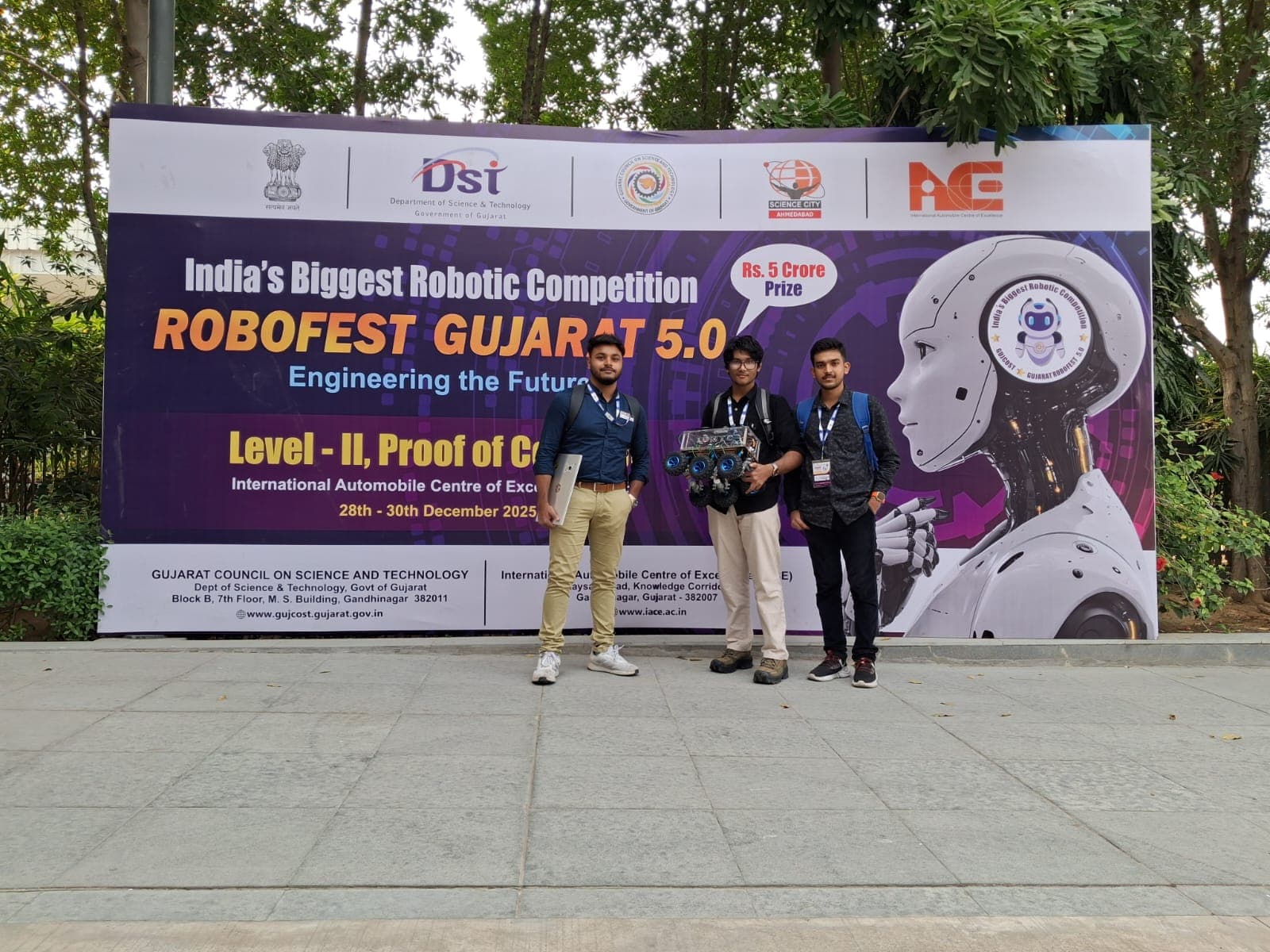
Meet Team Voyager Nexus
This project is driven by the collaborative efforts of our team members:
-
Malyadeep Sasmal (Team Lead)
-
Niladri Saha
-
Souvik Chakraborty
-
Debaditya Chaudhuri
The Vision: Beyond the Obstacle Course
Our goal was to design a robust rover that balances high-performance autonomy with cost-effectiveness. The Voyager Nexus isn't just a competition bot; it’s a platform designed with real-world applications in mind, from planetary exploration and defense to agriculture and disaster response.
The Architecture of Intelligence
To ensure the rover can "think" and "act" in real time, we developed a two-tiered control system:
-
High-Level Perception (Raspberry Pi 5): The "brain" runs ROS 2 and the Nav2 stack. It processes data from a YDLIDAR G2 for 360° mapping and an Intel RealSense D435 depth camera for 3D obstacle detection.
-
Low-Level Reliability (STM32L476RG): The "nervous system" handles deterministic tasks. It manages real-time motor actuation and processes feedback from wheel encoders and a 9-DOF IMU to maintain stability.
Engineered for Resilience
Building for the ground requires a different kind of "tough" than building for the water:
-
The Chassis: A hybrid design using 6061-T6 and 7075-T6 aluminum for high-stress fittings and structural rails.
-
The Suspension: We implemented an independent double-wishbone suspension with coilover shocks. This allows each wheel to move independently, ensuring the rover stays level while navigating rocks or slopes.
-
The Grip: The IDUINO 130mm rubber tyres feature aggressive, multi-directional lugs to maximize traction on gravel, grass, or loose soil.
Power & Safety
A rover is only as good as its uptime. We equipped Voyager Nexus with a 3S 11.1V 12000 mAh LiPo battery to support extended field missions.
Safety is baked into the code:
- Heartbeat Monitoring: The Raspberry Pi continuously transmits heartbeat messages to the STM32; if the STM32 detects missed heartbeats, it immediately stops all motor outputs to prevent accidents.
The Voyager Nexus represents months of interdisciplinary teamwork. As we prepare for the final obstacle course in Gujarat, we’re proud to showcase a system that combines advanced AI with rugged mechanical design.
Wish us luck at the Finals!